Bottle Flip 3D — Tap & Jump!
- 4.2
- Rating
- 100.00M
- Installs
- Free
- Price

 Analysis by App-foxy
I tend to judge casual games by a simple question: do they make a spare minute feel better, or do they turn that spare minute into frustration? Bottle Flip 3D sits firmly in the first group for me. It takes one familiar action—flipping a bottle and landing it upright—and builds a light, timing-focused game around it. The idea is easy to understand immediately, but getting consistent results takes more patience than the cheerful presentation suggests.
That makes it a useful choice for short breaks rather than a game I would recommend as a deep, long-term hobby. I can open it when I have a few minutes, play without studying a rulebook, and stop without feeling that I have abandoned a complicated story or team. At the same time, the simplicity is also the main reason some players will eventually want something else. If you need strategic depth, rich exploration, or a strong sense of progression, this is probably too narrow.
How I Decide Whether Bottle Flip 3D Is Worth Playing
My first decision criterion is control. A casual game can be simple without feeling random, and this one works best when the timing of the tap feels connected to the bottle’s movement. I pay attention to whether I can learn from a failed attempt. When a landing goes wrong, I want to understand whether I tapped too early, too late, or at an awkward point in the jump. That small feedback loop is what keeps the central action from becoming a pure coin toss.
You May Also Like

 AccuWeather: Weather Radar
AccuWeather Review: A Quick, Clear Forecast for Everyday Decisions
For everyday plans, the best forecast is the one you can understand quickly. AccuWeather makes rain timing, radar, and local conditions easy to act on, with a few trade-offs.

 Hill Climb Racing
Why Hill Climb Racing Still Turns Crashes Into One More Run
A tiny car, a bumpy hill and one more upgrade: Hill Climb Racing keeps resurfacing because its simple chaos makes every near-miss feel personal.

 AliExpress - Shopping App
AliExpress Makes Global Shopping Feel Personal, but Shoppers Bear the Risk
AliExpress turns a global marketplace into a pocket-sized discovery engine. Its reach is useful, its shopping loop compelling, and its trade-offs easy to miss.

 Lords Mobile: Kingdom Wars
Lords Mobile Is a Kingdom-Building Routine, Not a Quick Match
A case-by-case verdict on the building, battles, device demands, and social commitments that make Lords Mobile rewarding for some players and exhausting for others.

 PDF Scanner app - TapScanner
TapScanner Makes Paperwork Easier to Capture, Check, and Share
TapScanner makes scanning with a phone feel less like a rescue operation and more like a dependable step in getting work done. Its capture tools are useful, though not flawless.

 Block Blast!
 Shows How Much a Puzzle Game Can Leave Out
A quiet grid game shows why puzzle players increasingly value instant clarity, repeatable skill and low-pressure play—and where the genre still needs to catch up.
More From Our News Desk
View All News


The second criterion is the amount of attention the game demands. This is not something I choose when I want to relax with a podcast and barely look at the screen. The bottle’s movement requires visual timing, so even a short attempt asks me to focus for a moment. That is a strength when I want a quick mental reset, but it is less convenient than a turn-based puzzle that lets me pause and think whenever I like.
I also consider whether the game suits the device and the player. The age rating is Everyone, and the basic concept is approachable for children, adults, and anyone who enjoys uncomplicated reflex challenges. I would still make my own judgment for a young child, especially if repeated failure might be irritating, but there is nothing complicated about learning the main action. The minimum operating system is Android 7.1, which makes it accessible on many older Android devices.
On the store, it is listed as a free game, with optional in-app purchases ranging from $0.99 to $9.99 per item. That matters because the right way to approach it is as a free trial of the experience, not as a purchase I need to justify before I know whether the tapping feels satisfying. I would play the free version first and only consider spending money if the game had already earned a regular place in my routine.
The basic loop is quick to learn but not mindless
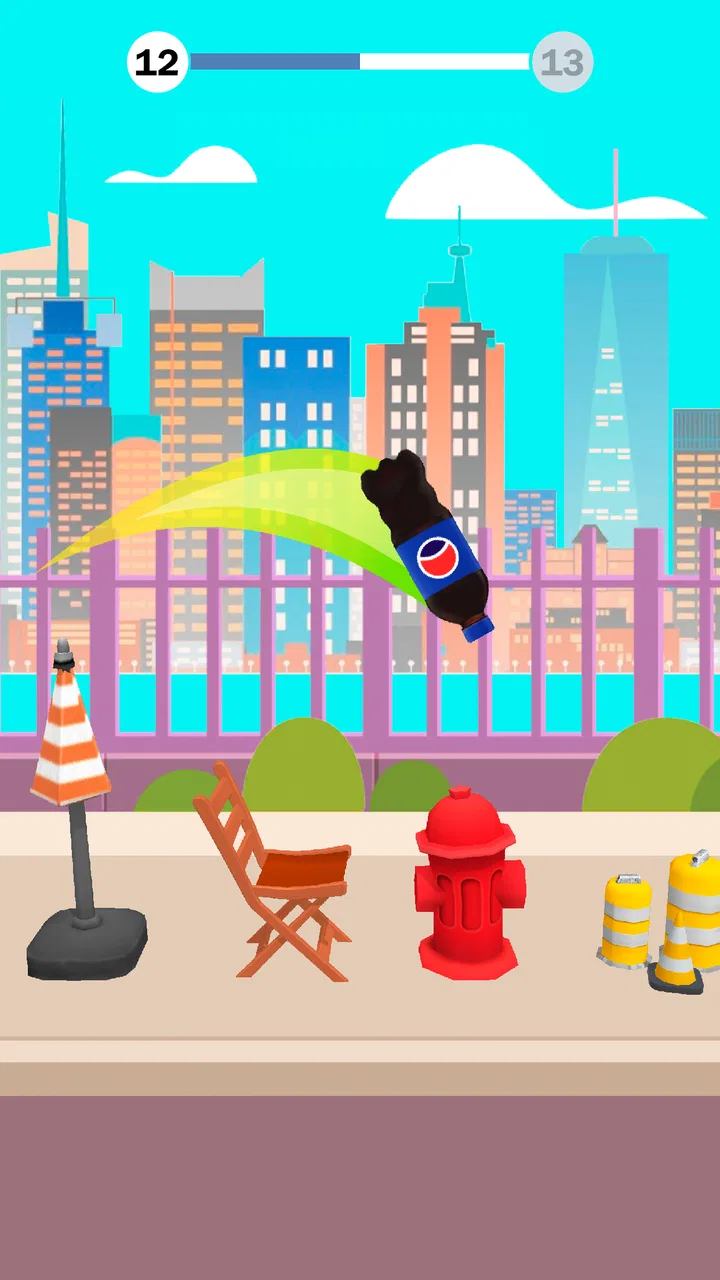
The main interaction is straightforward: tap to make the bottle jump, then try to land it upright on the next surface. The appeal comes from the narrow gap between understanding the action and mastering it. I can explain the game to someone in a few seconds, but that does not mean I will land every flip. Small changes in timing can make a successful attempt feel earned.
I find that the game rewards a calm rhythm more than frantic tapping. My first instinct in a difficult sequence is often to tap faster, but that usually makes my timing less reliable. A better approach is to watch the bottle’s arc, identify the next landing area, and treat each jump as an individual timing problem. This is one of the more useful habits I took from playing: slow observation is often more valuable than faster reactions.
That advice sounds obvious, but it changes how the game feels. Instead of blaming every miss on luck, I can look for a repeatable mistake. If I consistently tap while the bottle is still rising, I know what to adjust on the next attempt. The game becomes a small exercise in visual prediction rather than a sequence of random swipes or button presses.
Why it works well in everyday situations
I see the strongest use case during small gaps in the day. Waiting for an appointment, sitting on public transport, or taking a short break from work are all situations where I may want entertainment that starts instantly and does not demand a large time commitment. A single attempt can be engaging without requiring me to remember a plot, manage an inventory, or coordinate with other players.
It is also a reasonable game to pass around among friends or family because the rule is visible on the screen. Someone can watch one attempt and understand what is happening. That makes it more approachable than a competitive game with several controls or a puzzle whose solution depends on knowledge built over many stages. The fun is in trying to beat the previous result, not in explaining a complicated system.
For example, if I have a short break between errands, I can play a few rounds while standing in line. I do not need to prepare a loadout or remember where I left off. If the queue moves, I can put the phone away immediately. That kind of low commitment is where the game makes the most sense.
Where the game wins against other casual choices
Compared with endless runners, this game feels less dependent on steering through a constantly changing path. The focus is concentrated on the bottle’s jump and landing. Compared with match-three games, it does not ask me to scan a board, plan combinations, or wait for a satisfying chain. Compared with idle games, it gives me something immediate to do instead of asking me to return later for accumulated progress.
That narrow focus is its advantage. I know what I am practicing, and I can feel a small improvement when my timing becomes more consistent. There is less mental overhead than in many puzzle games, yet it still offers enough resistance to keep the interaction from feeling completely automatic.
The trade-off is variety. A match-three game can offer different board layouts and planning possibilities, while an endless runner may combine movement, obstacles, and collectible goals. Here, the bottle flip remains the central attraction. If that action does not feel good to you after several attempts, the rest of the experience is unlikely to change your mind.
Small techniques that make attempts more consistent
I found three practical habits more helpful than simply tapping harder. First, I keep the phone steady. Even a small change in how I hold the device can make my visual timing feel less dependable, especially when I am playing while standing. Second, I watch the landing surface rather than staring only at the bottle. The destination gives me a better reference for judging when to act.
Third, I treat a failed attempt as information. If I miss by a small amount, I adjust the next tap rather than changing everything at once. That is important because changing grip, speed, and timing together makes it impossible to know what actually helped. This measured approach is especially useful for players who normally give up on reflex games after a few mistakes.
Another practical tip is to avoid playing when you are distracted. The game is easy to start, but its timing is not ideal for multitasking. If I am trying to answer messages at the same time, misses feel arbitrary because I am not giving the bottle enough attention. A focused minute is usually more enjoyable than a longer session interrupted by notifications.
What may frustrate regular players
The same repetition that creates a satisfying challenge can become tiring. Once I understand the timing, I may want more than another attempt at a similar action. Players who need a strong narrative, character development, or a broad collection of mechanics should look toward another category. This is a compact casual game, not a substitute for a larger adventure or strategy experience.
There is also a difference between difficulty that teaches and difficulty that simply slows progress. When I can identify why I failed, I am willing to retry. When a sequence feels unclear, repeated attempts become less appealing. My enjoyment depends heavily on whether I feel that practice is producing better control. Anyone who dislikes retrying a short challenge may find the loop repetitive sooner than I did.
Optional purchases are another point to consider. The game costs nothing to start, but the presence of paid items means I would not hand the phone to a child without thinking about how purchases are handled on the device. I would also avoid spending impulsively during a frustrating streak. A purchase should improve convenience or enjoyment for a player who already likes the game, not be treated as a solution to poor timing.
Who should choose it, and who should skip it
I would recommend it to someone who likes simple reflex games, short sessions, and challenges that can be understood without instructions. It is a good fit for a casual player who wants a quick activity during downtime and enjoys practicing a single action until it feels more reliable. The Everyone rating also makes it an approachable family-friendly option in terms of its basic concept.
I would be more cautious about recommending it to someone who wants a substantial progression system or a game that remains fresh through many different mechanics. A dedicated puzzle player may prefer a title that rewards planning, while someone looking for relaxation may prefer an idle game that does not require constant visual attention. A competitive player may also find the experience too solitary or too limited compared with games built around direct multiplayer matches.
The decision comes down to what kind of friction you enjoy. If you like the mild frustration of being close to a successful landing and trying again, the game has a clear appeal. If failure in a simple game feels annoying rather than motivating, the lack of a broader activity to fall back on will make the weakness more obvious.
What to expect from the current release
The game is developed by Azur Interactive Games Limited and currently appears as version 1.11.10. It has been available since April 23, 2019, so it is not a brand-new experiment built around a temporary novelty. Its longevity and broad reach suggest that the central bottle-flipping idea has connected with a large casual audience, though popularity alone does not guarantee that its particular rhythm will suit every player.
It has an average rating of 4.2 from around 431 thousand ratings, alongside roughly 9.8 thousand written reviews. The game has passed 100 million installs, which places it among the more widely encountered casual titles on mobile. I read those figures as evidence that the concept is easy to approach, not as proof that it offers the depth of a premium console-style game.
That distinction helps set expectations. I would install it expecting a focused, free-to-start diversion. I would not install it expecting a long campaign, complex strategy, or a rich social world. Knowing that before playing makes the experience feel more honest, because the game can be judged on the quality of its small loop rather than on features it was never designed to provide.
Switching from another casual game
The cost of switching is low if you are coming from another quick-play title. You do not need to learn a large control scheme or change your whole routine. The adjustment is mainly mental: instead of planning a board or steering a character, you are watching an arc and choosing a tap at the right moment. Most players can understand that change immediately.
The bigger cost is giving up variety. If your current game keeps you interested through several modes, puzzles, or long-term goals, this one may feel smaller after the novelty fades. I would not replace a favorite match-three, runner, or idle game outright. I would add this as a different kind of break, then see whether its timing challenge earns more playtime than the alternative.
There is also a habit-related trade-off. Because the game is so easy to open, it can be tempting to retry a difficult sequence longer than planned. I find it helpful to set a natural stopping point, such as ending after a successful run or after a short break finishes. That keeps the game in its best role: a compact distraction rather than an obligation.
My recommendation
I recommend giving Bottle Flip 3D a try if you want a free casual game built around quick visual timing and repeated short attempts. Start without buying anything, play in a quiet moment, and pay attention to whether misses feel instructive. If you enjoy adjusting your timing and chasing a cleaner landing, the simple design is likely to work for you.
I would skip it if you are searching for a deep game, a story-driven experience, or a relaxing activity that can run in the background. In those cases, a puzzle, idle game, or larger adventure will probably offer a better match. This title succeeds by doing one thing clearly, not by covering every kind of mobile entertainment.
My final view is positive but measured. The bottle-flipping mechanic is accessible, portable, and surprisingly good at creating a small sense of mastery. Its limitations are just as clear: repetition, dependence on attention, and a narrow range of play. For short breaks and casual players, that narrowness is a benefit. For anyone who needs variety, it is the reason to keep looking.
FAQs for Bottle Flip 3D — Tap & Jump!
01What is the main objective of Bottle Flip 3D — Tap & Jump!?
The main objective of Bottle Flip 3D — Tap & Jump! is to flip a bottle through various challenging levels by tapping your screen to make it jump. Each level presents unique obstacles and platforms, requiring precise timing and skill to land the bottle upright. The goal is to complete each level without the bottle falling over.
02Is Bottle Flip 3D — Tap & Jump! free to play?
Yes, Bottle Flip 3D — Tap & Jump! is free to download and play. However, the game may contain in-app purchases and ads. Players can choose to buy certain features or remove ads for an enhanced experience. All essential gameplay aspects are available without spending money.
03What are the system requirements for Bottle Flip 3D — Tap & Jump!?
Bottle Flip 3D — Tap & Jump! is compatible with both Android and iOS devices. While specific system requirements can vary, the game generally requires a recent version of the operating system—Android 4.4 or later, and iOS 9.0 or later. It runs smoothly on most smartphones and tablets with these specifications.
04Does Bottle Flip 3D — Tap & Jump! offer different levels of difficulty?
Yes, Bottle Flip 3D — Tap & Jump! offers a variety of levels, each increasing in difficulty as you progress. The game is designed to challenge your timing and coordination skills with progressively complex platforms and obstacles. Players can enjoy mastering each level to improve their bottle flipping prowess.
05Can I play Bottle Flip 3D — Tap & Jump! offline?
Bottle Flip 3D — Tap & Jump! can be played offline, allowing you to enjoy the game without an internet connection. This makes it a great option for gaming on the go or in areas with limited connectivity. However, some features, such as in-app purchases or certain updates, may require an internet connection.
Pros
- Simple and addictive gameplay.
- Colorful and engaging graphics.
- Quick rounds for short play sessions.
- Easy controls with a single tap.
- Suitable for all ages.
Cons
- Repetitive levels may get boring.
- Contains ads and in-app purchases.
- Limited customization options.
- No multiplayer mode available.
- Occasional lag on older devices.

Bottle Flip 3D — Tap & Jump!
Gallery